Sunday, 24 January 2016

The Slave of Duty

I've been saying from the beginning that Baza reminds me of my own small town - a lovely, charming, healthy place to grow up - but it's a stifling place for young people to live, with little higher education, opportunities or excitement for those longing for a taste of the world.  This is hardly more evident than in languages.

I moved to Spain to learn Spanish, to immerse myself in the language so completely that I'd be oozing castellano out of my ears.  Well, sleepy, rural, monolingual Baza is the perfect place for me to fill my aural cavities with stuff that would bewilder an ENT, but for those trying to go the other way, Baza is a vast, hopeless wasteland.

Despite the number of British retirees kicking around in this part of the world, hoping for some sunny peace and quiet to finish out their days, Baza is very much a one-language town.  While, as in Australia, most of the more common languages can be found and used in the big cities, once you hit the countryside your chances of finding a second language start to plummet, and the young English-learners of Baza are a tad desperate.  My first few weeks in Baza were about finding ways to politely tell people that no, they couldn't book one of my private English classes because I wasn't running any private English classes.  This threw more than a few people for six.  In a town where native English speakers pretty much consist of the overseas language assistants (and those reclusive retirees), classes with us are in high demand.  I discovered during my first week at flamenco class that my teacher was the woman who'd sent a message via my high school that she wanted to host the school's language assistant, in exchange for said assistant (me) speaking English to her two girls at home.

While I quickly nixed that idea (and my coordinator promptly 'forgot' to ask me until I'd 'already' found my own apartment), she wasn't the only one.  Another teacher approached me on first meeting to ask about setting up an English-language play session with her under-10 daughter and her friends, and didn't seem to believe me when I said that sorry, I wasn't offering classes.  I was even chased down the street one night after leaving a shop because the shop girl wanted to know if I'd help her practise English every week.  After a very long chat in Spanish, during which she explained that she's undertaking post-secondary studies through a local high school and attending a private language school in the afternoons, I had to tell her that I've in fact come to Spain to learn Spanish, not to help all of Spain learn English.

In amongst all her pleading, though, she raised a really good point.  There are a lot of people in this town that really, genuinely want to learn English - far more than you'd find wanting to learn a second language in Australia - and almost all of them have no opportunity to practise with a fluent speaker, let alone a native speaker.  Even the English-speaking teachers in the bilingual program at my school don't speak English in class nearly as much as they speak Spanish.  Granted, the kids often need Spanish translations to help them follow the English explanations, but they get little enough English as it is.  I often represent the biggest English-language influence in these kids' lives, and for some of them it's all of half an hour a week.


So it leaves me feeling more and more guilty, every time I say no to someone and leave them to founder through their English studies at home. As one of Baza's only English speakers, I feel almost duty-bound to offer English classes not because I want to, but because so many people around here need them and they just don't have any other options.  It seems kind of hard to justify my efforts for one person to learn Spanish - me - when I could be helping 20 or 30 other people to learn English!  The problem is, I've paid $2,000 in the form of a return plane ticket in order to learn Spanish, and €8/hour for English classes can't even hold a candle to that.  Of course, guilt is so nobly above such mercenary considerations and nags at me all the same.

In fact, I had this entire conversation with one of the women in my flamenco class a while ago.  What's most remarkable is while I completely understand the perspective of all the locals here who are pestering me for lessons, it appears that not one of them can see my point of view!  Even when I point out that I work at a school speaking English to the kids all day long and don't want to trot off to even more classes in English every afternoon, everyone seems to think I'm making a funny.  Heaven forbid that I moved 16,000 kilometres around the world to live in a country that speaks the tongue I want to speak day in and day out - oh no, I must have flown for a over a day and a half just to spend all my time speaking to them in a language I can find back home!  Of course, that makes such good sense - at least, it does to them!

Sunday, 17 January 2016

¡Feliz Navidad!

Christmas in Spain has been quite the experience, and I've had to wait until mid-January to write this post, because that's how long Christmas takes in Spain. Let me give you the run-down...

Firstly, Baza got all dressed up for Christmas.  All the streets had giant fairy light murals hanging over them, and Plaza Mayor was awash with lights.  It was fun taking walks just to see all the lights around town.


I spent Christmas Day at home in my apartment in Baza, with my family on Skype doing trivia quizzes and opening presents.  I spent most of Christmas Eve cooking, so for Christmas lunch I put on a pretty dress and had a lovely homemade gluten-free, lactose-free spinach and capsicum lasagne, followed by a lactose-free apple crumble.  This was followed by three days of near-comatose lounging.  So that I didn't spend the whole holiday season alone, I headed to Seville on New Year's to visit a colleague from school (but that's a separate post).


Thing is, December 25th is not the big deal here in Spain.  They're less fussed about the birth of baby Jesus, and more fussed about when the Three Wise Men rocked up to celebrate.  In Spain it's all about the 12th Day of Christmas, January 5th - better known as Los Reyes Magos.  It's marked by a parade called La Cabalgata de los Reyes Magos, when the Three Kings arrive to give presents to baby Jesus and any stray children who might be hanging around...by which I mean every child under 10 in town.

I was advised by one colleague to go to Granada to see their much bigger, better cabalgata, but I decided I'd rather stay home in Baza and see whatever the local celebration looked like.  I did not regret it.  Overlooking the steady rain which gradually drenched the parade (and all attendees), it was a much bigger, louder, more colourful and celebratory event than I'd expected.  Because of the circuitous route I actually got to see the whole parade twice - characters in costume, two bands, floats featuring popular movie characters, a dance troupe, and finally the three throned floats carrying the Three Kings into Baza, everyone throwing buckets of lollies to the crowd the whole time.


Mary Poppins and her chimneysweeps!


Donald Duck here is Blanca, one of my students


The parade eventually made its way to Plaza Mayor, where a stage had been set up with three canopied thrones, though by the time the parade arrived the thrones had been hidden from the rain.


The kings instead appeared on the balcony of the archaeology museum, and after Balthazar, Caspar and Melchior had introduced themselves and blessed the town of Baza, the sky suddenly exploded with fireworks right overhead in Plaza Mayor.  The square was illuminated by flares coming off the balcony, and for a few minutes the whole of Baza was transfixed in a show of light.  Of course, about five minutes later the soaking rain was enough to send me running home, so I never did get to find out if the kings ventured out to meet the children or not.  Still, a fascinating and lovely tradition to add to the yearbooks!

Thursday, 14 January 2016

10,000 Hours

That's how long science says it takes to master a new skill. Whether it's cordon bleu cooking, playing a musical instrument, writing computer code or learning a language, research says you need 10,000 hours of practice to really become a Jedi at something. For those of us learning a language, that equates to just over 6 months of immersion in a language, which is probably why we hear that so often quoted as the 'magic number'.

That was my plan in moving to Spain - just being in a place where everyone speaks Spanish 24/7 would help me rack up my hours pretty fast. Since my plan of finding a host family to avoid my French mistake of 'French at school, English when I'm home alone the rest of the time' ultimately proved fruitless (and probably just as well, because I think I would have snapped and done them all in by now), I put aside money to enrol in a zillion extracurriculars. Thanks to my weekly yoga class, not only am I more relaxed, but I know all my body parts in Spanish. Flamenco is not only heaps of fun, but I can intimately describe my foot in Spanish as well as different ways of moving my body. My monthly book club has so far not given me a lot except for better knowledge of Spanish literature, and an appreciation for the amount of noise generated when six people all speak at once. That happens at last three times per meeting.


These have all proved to be great ways to make friends, too. My flamenco class all went out for drinks after class some weeks back and, despite my best intentions, I rolled home three hours later stuffed full of every gluten-free vegetarian tapas they could think of (they were tasty, too). Earlier this week I dropped into the library to collect the lastest novel for my book club, ran into Ana and Berna, two older ladies who think the token Australian girl is adorable, and wound up having mint tea in a local cafe discussing I really have no idea what.

What's interesting for me is that perhaps my most fruitful interactions and relationships are the ones that shouldn't be bearing fruit at all. Every fortnight or so I see a local masseur for a shiatsu massage - it's 20€ an hour here and in Aus it'll cost you $40 for half that time, so I take it and run. Pako the masseur is a lovely, spiritual, philosophical guy, and he loves a good chat after I've woken up from my deep-sleep massage state. I'm pretty sure after four months of regular appointments we've solved world peace about three times over by now.

The other relationship that's been surprisingly helpful is Rosa. Keeping up the tradition of monthly manicures that I developed with my friends, I've become a regular at a local beauty salon. The things about small businesses like Rosa's here in Baza is that while your appointment might get interrupted occasionally when they go to answer the phone or door, your appointment gets full personal attention. No minions or lackeys here. Rosa herself does my manicures, and because I'm a regular we always end up chatting while she works, about the weather, about school, about my mum coming to visit, about what pattern we'll paint on my nails this week, anything and everything. It's a full hour of one-on-one chatting, which is much easier for me to understand than a multi-person conversation, and I usually get some good vocab out of my conversations with Rosa (daily vocab gets written on the back of the left hand, as Rosa well knows!)


So it's been funny for me sometimes, when I mentally tally up my hours of Spanish interaction for the week and think that yoga + flamenco + book club falls short, to realise that I have to factor in a massage (we chat with the receptionist, too!), or a manicure, or my walks home from yoga with my neighbour and teacher, Miryam, or lunches with colleagues from school...point being, I'm taking in a lot more Spanish than I sometimes think I am!

Thursday, 24 December 2015

Road trip!
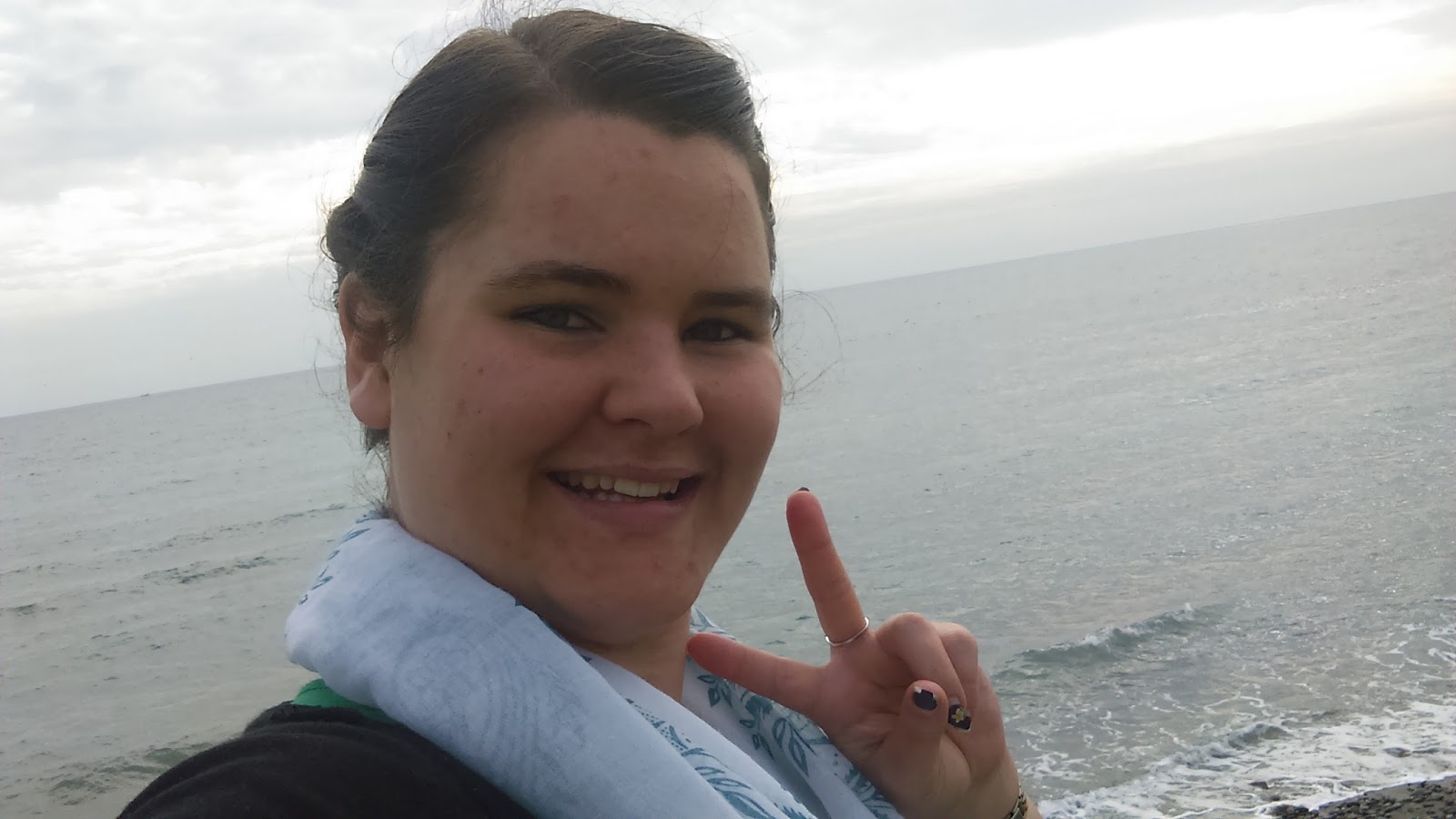
Over my birthday a few weeks back, Fate handed me a super-long weekend, so I decided to do something special and planned myself a little road-trip.  I picked up a really over-priced hire car from Granada and headed west across Andalucía, passing through Ronda, Cadiz, Tarifa and Gibraltar.  Since I've been uber-lazy with the blog and there's too much to fit into one blog post, here are the highlights of my trip...

Discovering the oldest bullfighting ring in Spain


Exploring the hillside towns of Malaga province

Checking out the Old Bridge of Ronda

Looking across to the mainland from the island city of Cadiz

Looking out over the coast of Spain from the Cadiz Cathedral
 
Seeing the Trafalgar Lighthouse

Standing at the southernmost point of Europe - Tarifa, Spain

Looking over the Strait of Gibraltar to Africa

Watching glassblowers at work in Gibraltar

Meeting Barbary macaques in Gibraltar

Climbing the Rock of Gibraltar! 

Celebrating my 23rd birthday in style on the Costa del Sol

Sunday, 29 November 2015

Violence Against Women: Baza Says NO!!

Wednesday was International Day to End Violence Against Women. Despite being a proud feminist, it’s never been a big ‘event’ in my life, like Daffodil Day or Remembrance Day, so I put on my shoes and scarf and went to school as usual.

However, El Día Internacional Contra la Violencia de Género is a pet project of the deputy headmistress. Loli is a tiny, motherly woman who reminds me of a more smiley Professor McGonagall, and when Loli wants something to happen, it happens. With recruited student labour, Loli orchestrated a whole-school assembly commemorating Spain’s 54 victims of domestic violence and violence against women this year. As one student read out the name of every victim, one by one, another student laid a card with their name on a homemade floor poster of purple and white, while a third placed a lit candle on a second purple floor mat in the pattern of the symbol for the Day to End Violence Against Women.  This was followed by two students singing ‘Jueves’ (‘Thursday’), which was written for the 2004 Madrid terrorist bombings, accompanied on the piano by Bernard, one of my Year 11 students who studies at the music conservatorium next to the school.


Outside in the sports arena, various class groups were taking it in turns to run laps of the school yard to a total of 48 kilometres over the whole day – one kilometre for every adult victim. I joined one of my classes for a few laps just as Jiminez Montoya, another high school backing onto our sports area, released a bunch of white balloons in memory of the victims. Meanwhile, the Year 9s from Jose de Mora went to Plaza Mayor during 4th period for a service with the town. Later that afternoon one of my girls handed me one of the knitted white symbols they were handing out in Plaza Mayor to pin to my scarf.


While I appreciate the importance of the occasion – as an educated adult woman, it’s hard not to – but I’ve never lived in a place that afforded the International Day to End Violence Against Women its due worth. What’s even sadder is that Australia has even more victims of domestic violence for 2015 than Spain does, and our population is half of theirs. But this year’s Australian of the Year is Rosie Batty, our most recognised survivor of domestic violence, so maybe we’re getting somewhere.

Those candles for the 54 victims continued to burn in the school’s vestibule all afternoon, as a mark of respect. And as I walked home through Plaza Mayor that evening, I saw this hanging from the town hall:


I get mixed messages in Australia sometimes, but Baza certainly says no.

Thursday, 19 November 2015

In The Bleak December, or, 6 Ways To Spend Christmas In A Foreign Country

As December approaches, I'm faced with a rather difficult and thought-provoking dilemma - what am I going to do about Christmas?

For me, Christmas is mostly about family.  In Australia, Christmas also represents the end of the school and working year, the end of the calendar year, the start of summer and the holidays, and the beginning of a brand new lap around the sun.  It's basically a big party to round out the year, filled with food and laughter and gift-giving and general merriment, all dedicated to cherishing the people nearest and dearest to you.  That's what Christmas means to me; only this year, living 16,000 kilometres away from home means that I won't have any of it.
Paris Christmas Night Market, 2012
This is not the first time I've had to find a way to celebrate Christmas on my own.  When I was on exchange in France a few years ago I likewise found myself at a loose end during the Noel holidays, as all my European and American friends flew home to be with their families.  The Australian expat group I'd discovered all scattered to their respective families for the big day.  I couldn't even find a bunch of old French nuns taking in poor lonely students for a bit of a Christmas lunch.  I ultimately spent most of the day cosily in bed with my second (or perhaps third) dose of merry old flu since arriving in Europe, and by the time a group of Brazilian friends I'd invited for 5pm finally showed up around 10pm, I was wrecked, ready for bed and a terrible hostess.

So, this time around I've decided to plan ahead instead of winding up in a cold and lonely apartment on December 25th without even a Christmas tree for company.  Thus, below are a number of ways to pass Christmas Day when you're all dressed up in a foreign country and nowhere to go:

1. Have a quiet affair at home
The most simple option is, after all, to stay home and have Christmas in my apartment here in Baza, and with a bit of pre-planning it needn't be the rather pathetic affair it was last time!  With a Christmas tree, some nice decorations, my favourite Aussie Christmas carols and a good meal for Christmas lunch, there's no reason it can't be merry, and I can Skype my family back home to open presents and share the day with them courtesy of modern technology.  Staying in Baza means I can also experience the local build-up to Christmas, whatever that may look like in small-town rural Spain, and enjoy the sense of community that I love around here.

2. Adopt myself out to a local Spanish family
If any Spaniards in Baza are reading this, one Australian girl with puppy-dog eyes seeking half-day adoption for Christmas!  Will bring presents, cook food and be extremely cheerful.  Can be returned to owner/own apartment when sufficiently glutted on eggnog and Christmas pud.

Spending the day with a Spanish family would also mean that I could see all the town Christmas preparations and even Skype my family on the day as well.  Only problem is, Baza doesn't seem to have a human adoption agency somehow!

3. Fly solo - literally
The extended Christmas holidays would be the perfect opportunity to take a long trip somewhere that I haven't been, like Portugal, Africa or Ireland, or even re-visit somewhere I have, like France or England.  Despite my four-day week, trips beyond Spain or even Andalucia aren't an easy proposition, so Christmas gives me just the excuse I need to hop on a place and run away from Spain.  Of course, taking this option means on Christmas Day I'll wind up in a random hostel wherever I happen to end up, with no guarantees of good company or Christmas cheer, which doesn't sound like the greatest version of Christmas to me.

4. Misery loves company
The useful thing about being me is that I've got friends scattered all around the world - and they're concentrated in Europe!  Off the top of my head I can think of three or four other Aussies living away from home who might appreciate some familiar company to make Christmas a little less...well, sad. Whether I go to them, they come to me or we both meet in a third location, I'm sure two lonely hearts can find a way to make Christmas more fun for the both of us!

5. Find a surrogate family
Instead of heading off a trip and trusting to Providence about where I land on December 25, I could always head back to somewhere I've been before that would open its doors to a bunch of strangers all looking for a bit of Christmas love.  I'm thinking specifically of a hostel in Scotland where I worked briefly as one of the team, and which would be happy to welcome me back into the family.  Chances are there'll be a few other lost souls who've wound up there for Noel, and we'll make our own Christmas together - probably involving haggis and getting drunk on eggnog flavoured with local Scotch whisky!
The delightful Fort William Backpackers' in Scotland
6. Ask Santa for a teleporter for Christmas
Though to be honest I'm not quite sure how he'd get into my apartment, since there's no chimney....

There's well over a month before Christmas, so I still have time to decide on the lonely fashion in which I'll try and make the best of December 25th.  Mind you, if anyone can sell me on any of the above options, or come up with a better one, then I'm all ears! ¡Vámanos!

Sunday, 8 November 2015

Down The Rabbit Hole

Ever since I arrived here, people have been asking me the same three questions: where are you from (Australia, easy); why on earth did I decide on Baza (I didn't), and; do I like Baza (I do). When they ask why the last answer, I've learned how to explain that I come from a small country town much smaller than Baza, and I like the cosy feel and friendly community atmosphere that both towns have in common. I think I've  floored a few people with that response from a 22-year-old.

But there's another increasingly significant reason why I like Baza. In terms of history, historical sites and cultural traditions, Anglo-Saxon Australia is pretty skint. The main attraction in my town is an 1850s gold mining battery, which is stored in a shed. So, if you go sightseeing in my town, you'll see a shed. The main street is pretty, I'll grant you, but it's just like any other street.  It lacks excitement.

Baza, on the other hand, is everything that my town lacks.  As I learned this weekend, Baza is a former Moorish (Arabic) town, with some of the buildings dating as far back as the 12th century or more.  Every time I step out of my apartment I'm entering a veritable wonderland of living history, beautiful scenes, unusual buildings and fascinating places.  Even something as simple as a trip to the doctor can be like falling down the rabbit hole, wondering where I'm going to end up or what I'm going to find along the way. My flamenco classes, for example, are in the Casa de la Cultura (Culture House), which used to be the Casino de Artesanos (Artisans' Cottage), about 200-odd years ago.  My yoga class is in a side street off Plaza Mayor, which backs onto Iglesia Mayor, which started life as the main cathedral for Guadix-Baza diocese some 500 years ago.  Every time I head out to do a Reclining Mountain Pose I pass by 700 years of imposing stone history on my way.


Amongst my explorations this weekend, I made my way down to the baños árabes, or Arab baths, which were built sometime back in the 12th century.  In Moorish times the baths served a three-fold purpose: promoting good hygiene, providing a social gathering place for the locals, and; enabling Islam's ritual bathing.  Most people met for a weekly catch-up in the largest central 'warm' room, while massages and more deep-cleansing scrub-downs were on offer in the 'hot' room, which disseminated its heat through the rest of the building.  A 'cool' room, boiler room/wood shed and welcome vestibule made up the rest of the facility.  The baths have now been preserved and opened to the public, though as the ground level has risen somewhat in the last 1,000 years, visitors now enter at the roof level of the old baths and peep over the railing into the boiler room before descending into the vestibule and touring the baths the way bathers would have done a good 10 centuries ago. 


The Arabic baths
Lucernas in the warm room
The hot room
Looking from hot to warm
Warm room skylights
But I think my favourite discovery of the past few days has been the Plaza de los Moriscos, or Square of the Moors, tucked away off a series of pedestrian-only streets in the suburb of San Juan.  On one side of this quiet, innocuous little grotto is a triangular house covered in fist-sized hemispheres with a little peak on each.  Famously called the Casa de las tetas, or 'The Boobs House', there is something delightfully incongruous about the well-kept balconies of greenery, on a pretty whitewashed house across a quiet square from a marble fountain, surrounded by hundreds of stonework models of the naked female nipple.

Plaza de los Moriscos
Casa de las Tetas
Lovely flowering balconies
I also took a peep inside the church of Saint James, one of many churches I've seen around Baza (well, I've seen their bell towers, at least.  I've yet to find most of the churches attached to said towers). It's the first church I've been inside since arriving in Spain, so it's hard to say what's normal, but it's nowhere near so elaborate as the churches in Italy, or as Gothic and gloomy as those in France.

Then, of course, there's the many other side streets and back streets and narrow streets and not-streets that populate Baza, the churches and ermitas and fountains and nooks and crannies and doorways and balconies and inumerable other quirks that make Baza such a magical place to live and explore.  There's even a working mule, complete with saddlebags.

Yes, I said this was Wonderland.

Plaza de Santiago
Iglesia de Santiago
Calle Acequita
Callejón Poyos (I think)
In the old arrabal of Marzuela
The back streets of Wonderland
Caños Dorados - Fountain of the
Golden Pipes
The north-west corner of Baza
It has a TOWER!
Calle Chorrillo
Panorama of Baza from the Alcazaba
Eastern Baza
North-eastern Baza and Iglesia Mayor
Iglesia Mayor by sunset
Plaza de Santiago by night
The Church of Saint James again